In the past month, I've written about Creative Tribalism both in Genre Hacks and in Moviemaker Magazine, and I suggested that 21st century artists need to position themselves at the center of concentric circles of 30-100 people. This digital tribe becomes the reliable, long-term source of creative fulfillment and spiritual meaning regardless of whether the writer, actor, or musician makes it big.
But how do we form these circles of deeply engaged tribespeople?
It's not easy. American consumers of art and entertainment are passive. They buy books, movie tickets, and downloads only when prompted by multimillion-dollar corporate marketing campaigns. They support the work of superstars with whom they will never interact. Online they are distracted by billions of competing memes, messages, and media-motes - a cacophony of voices all screaming over one another, "Look at me! Look at me! Look at me!" The biggest obstacle in building an audience is getting anyone to pay attention.
The solution simply can't be more self-promotion, dogged networking and inbound marketing. If we want our audiences to spend a larger slice of their entertainment budget on small artists with whom they can have a direct relationship, we have to take a break from our relentless drive to be the center-of-attention.
Leading by example, we must become supportive and engaged tribespeople in circles other than our own. As artists we must, first and foremost, show people what it means to be a patron.
A patron is neither a consumer of a product, nor a supporter of a cause, but rather someone who endorses and funds the work of an individual artist. A patron spends $10 on a download (A book, a song, a movie, whatever) not necessarily for the product itself, but to directly support the people who made it. What they get for their money is a relationship to the work and to the artists they admire.
Sadly, too many writers, filmmakers, and musicians (and I include myself in this criticism) busily ignore the work of other artists who desperately need their support. We all need to be better models of the kind of audience we want to attract for our own work.
Look around and ask yourself, whose work deserves wider notice? Whose project needs your collaboration and endorsement? Whose Kickstarter campaign have you promoted other than your own? How many reviews of festival films or web series have you written just to trumpet the achievement of the people who made them? Do you spend time reading rough drafts, watching rough-cuts, and critiquing one-sheets so that you can offer your free advice and feedback?
How often to you post, tweet, comment, and blog about the creative work of others?
Being a patron means taking a break from writing your TV pilot, editing your micro-budget feature, or promoting your next gig. It means looking beyond yourself as the center of the creative universe. It means paying attention and reaching out. This is what we want our collaborators and audiences to do, so we should start by doing it ourselves.
Perhaps I'm writing this very article to challenge myself to practice what I preach: By being better tribespeople we take the first step in forming tribes of our own.
Showing posts with label Creative Tribalism. Show all posts
Showing posts with label Creative Tribalism. Show all posts
Monday, July 7, 2014


Monday, June 9, 2014
Creative Tribalism
Rather than count on fame and fortune, 21st-century writers, filmmakers, and artists ought to concentrate on building tribes of 30-100 people who are deeply engaged in their work.
I do a lot of non-fiction reading in the areas of emerging technology and evolutionary biology, subjects which don't seem to have a direct relationship to creativity. However, as I consider the deep sense of frustration I see among artists/storytellers trying to "break in" and "make it," I sense a disconnection between our global, technologically-driven economy and the natural psychology of the artist - one that emerged over the last million years.
In a recent book, The Second Machine Age - Work, Progress and Prosperity in a Time of Brilliant Technologies, Erik Brynjolfsson and Andrew McAfee argue that we are in a second, digital "machine age" (the first being The Industrial Revolution.) In this new environment, computer technology has produced an economy that favors superstars over local players. Generally speaking, The internet and telecommunications technology have allows anyone in the world to take business from players who were once protected by barriers of geography and cultural access.
More specifically, or writers, filmmakers, and artists this has created a "winner-take-all" marketplace in which a small number of superstars, like billionaire J.K. Rowling or franchise demi-god J.J. Abrams, reach a global audience and the rest of us, millions and millions of us, toil away in relative paucity and obscurity. The internet may have allowed anyone to publish a book or upload a film, but the global flood of content drowns all but the lucky (and well-marketed) few. Artists find their work reduced to memes struggling in a environment of survival-of-the-stickiest.

Now, I myself loved reading the Harry Potter series to my daughter, and I'll be first in line to see the upcoming Star Wars film. But, the problem for artists who don't happen to be global superstars is that the creative psyche evolved in a very different environment.
 |
| Frontier Magazine, No. 9.6, (2003) |
Consider a Paleolithic tribe of about fifty members. Among the hunters and gathers, I'd argue that there were 1-3 individuals who were best suited to contribute to the group as a whole by being storytellers, mask-makers, or cave painters - in other words, artists. Every tribe had there very own J.J Abrams and J.K Rowling. I'd argue further that one out of every thirty or so people, has the genetic pre-disposition to be the tribe's "artist" and that this individual isn't likely to feel successful, happy or fulfilled doing anything else.
However, in our "winner-take-all" global environment of media superstars, an awfully large number of people are set up for for disappointment, frustration and even alienation. For one out of every thirty people on the planet, the chance of success and fulfillment is literally a million to one.
We all need a different model of success, one that requires creatively minded people to build circles of 30-100 people who are deeply engaged in their work. Whether or not one "hits it big," this circle becomes the center-of-gravity for creative growth, psychological health, and spiritual meaning. I'm calling this "Creative Tribalism."
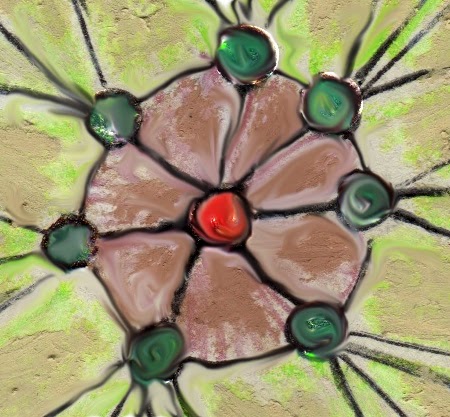
 The next circle is 30-100 people who make up your core audience - people with whom you have a direct two-way relationship and for whom you create your painting-film-whatever. These connections may be primarily internet driven, but this audience is deeply engaged with your work.
Further concentric circles may contain 3,000, 30,000 or even 300,000 passive consumers of your art, and the next ring in particular is necessary to make a living (more on that in future blogs.)
However, because our social behavior and emotional drives evolved in tribes of 30-100 people, close relationships with the first two circles are what delivers the very sense of fulfillment and purpose that so many creative people crave.
In fact, I'd argue, the absence of a closely knit tribe is precisely what is missing from many "successful" artist's lives. Without these relationships even superstars can become just as depressed, alienated, and unfulfilled as anyone else. (This is a subject worthy of it's own blog article.) In order to continue developing and flourishing, artists at all levels must build a tribe. (For a grim reminder, read
The Dangers of Success: Isolation and Loneliness)
Creative Tribalism is not the same as “networking.” I’m not talking about career advancement, attracting followers or inbound marketing. I’m arguing that direct and collaborative relationships with a small tribe — a group of people who deeply value an artist’s work — are essential to his and her sense of purpose and wellbeing.
In the upcoming summer issue of MovieMaker Magazine, I interviewed filmmaker Joe Swanberg and actress Melanie Lynsky. In that article I argue that Creative Tribalism is precisely the model ALL emerging filmmakers should be using, whether they aspire to be the next Swanberg or the next Spielberg.
In future blog posts, I'll flesh out these ideas further. Some might argue that artists-building-tribes is hardly anything new. But, I'll argue that Creative Tribalism is a distinctly 21st century phenomenon in which the artist uses the same globalizing technologies to build relationships and nurture a sense of fulfillment.
Specifically, for the first time, writers, filmmakers and artists have access to:
- Affordable technology that allows a single individual to create a piece (like a film, a song, or book) that previously required an industry.
- The digital connectivity that allows an artist to identify potential collaborators.
- The digital distribution needed to reach a widely-dispersed niche audience.
- The social networking needed to maintain the engagement of that audience.
But more on that later...

Have thoughts on "Creative Tribalism?" I write this blog in order to connect with intelligent, ambitious, and creative people. If you leave a comment, you will inspire me to write more. If you liked the article, please share it.
Have thoughts on "Creative Tribalism?" I write this blog in order to connect with intelligent, ambitious, and creative people. If you leave a comment, you will inspire me to write more. If you liked the article, please share it.
Subscribe to:
Posts (Atom)