Showing posts with label Novel. Show all posts

Wednesday, November 20, 2013

Publishing Screenplays as Ebooks: eScriptsHub

There was a time, and it feels like not that long ago, when screenwriters would go to Kinkos and run off fifty copies of their scripts in order to send them to agents, producers, and anyone else who might be willing to read them. Now there are numerous ways to showcase a screenplay on digital platforms, including publishing that script as an eBook.

I've investigated several ways of creating such an eBook. Some services advocate translating the script to a simplified novel (Aisle Seat Books), and other books and blogs tell scribes how to just tinker with a traditional script file and upload it to Amazon (see: How to Publish Your Script or Publish Your Screenplay on Kindle eBook, by London Tracy.)

However, nobody seems to have really found the right format, connected movie scripts with a viable market of readers, or provided an easy way for screenwriters to make the transition.  Ken Miyamoto thinks he's solved the problem.

If you have already read Ken's smart and entertaining Quora answers on the craft of screenwriting, you know he is a man who knows what he is talking about. I recently had a chance to interview him about his latest venture...

You have been a professional screenwriter for many years. What motivated you to create eScriptsHub.com?

Rejection. 

As screenwriters, we pour our hearts and souls into our stories. We spend anywhere from a few months to a year or more on each script that we write. And what do we want to do the moment we finish that final draft? We want to take it to people that can get it made.

And then what happens? Most of the time… nothing. Because getting a film made is difficult. It’s damn near impossible. Even making a sale on a spec script is damn near impossible these days.

That’s what is unfortunately unique about screenwriters. We only have one platform for our work to be seen. On the screen. If the scripts aren’t produced in whatever fashion, nobody sees it. Our stories aren’t told. They are left in the void of our own imaginations.

So I started to think about the thousands upon thousands of great screenplays that will never see the light of day. They’ll never find an audience. That’s a shame.

Then I started to look at my own spec scripts, thinking, “Gosh, I’d love for them to have an audience.” Then I started to look at the current craze of ebooks and the idea that these undiscovered writers are self publishing their own ebooks on Amazon. Garnering hundreds of thousands of readers.

Thus my idea of eScripts was born. The thought was to create a hybrid of ebooks and movie screenplays. To create a format that popped off of the screen of those Kindles, iPads, and PCs.

eScriptsHub.com itself started as a drop page to my own eScripts. Then I began to think that if I really wanted this new format and platform to grow, we’re going to need to drive a universal format (i.e. the format I cracked) into the mix to offer readers some consistency. So I created the Hub to be a central gathering point for this format and platform, offering screenwriters everything they need and also offering readers a place to learn more.

How is an eScript different in format than a regular script?

Many of the scripts being self published on Amazon were converted PDFs. They look horrible on Kindles, Nooks, tablets, and PCs. That format and the fonts that we normally write screenplays with just don’t pop off of the screen like an ebook.

The format changes that I eventually made to eScripts came to me by chance. I eventually discovered that moving almost everything to the left margin made the read so much better.

And here’s the kicker. Because we are trying to find a new audience with ebook readers, it created the perfect hybrid for them. They are used to reading from the left margin. Their eyes are tuned to that scanning, as opposed to going from left margin to center margin back and forth, back and forth, between scene description, dialogue, etc.

Beyond that, with eScripts, we’re allowed to use chapter headings, images, and can allow ourselves to use an extra few lines or so here and there in our scene descriptions because we don’t have to abide by Hollywood standards.
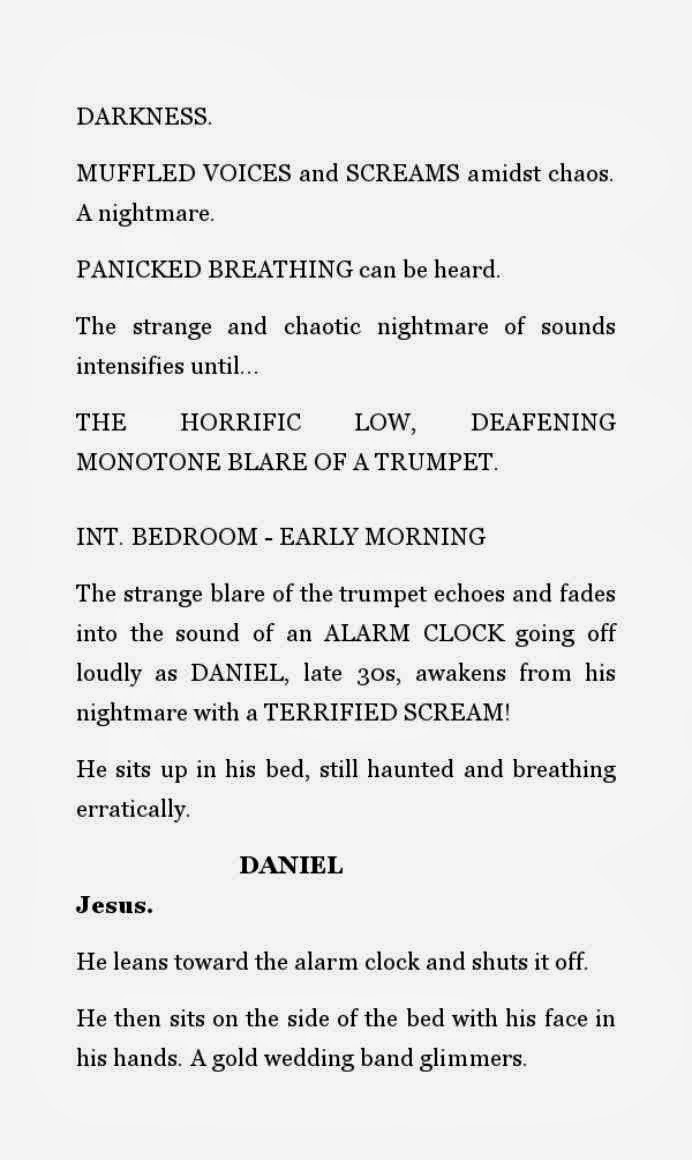


Reading screenplays, because they are essentially just a blueprint or armature for a movie, is generally less fun that reading books or even plays. Why would ordinary people read eScripts?

I disagree somewhat. To me, reading screenplays is a whole new medium of storytelling for readers. A visual medium. It’s the perfect hybrid of literature and watching movies; two of the world’s most favorite past times. And eScripts are the truest form of that perfect hybrid.

Beyond that, the exciting factor for readers is that they can experience a whole story, told in visual flare, in just two hours worth of reading, if that, per each eScript. As opposed to the commitment of multiple hours, days, weeks, and sometimes months of reading an ebook.

eScripts are perfect for lunch breaks, late night reads before bed, while waiting for their flights in the airport, etc.

If the format is easy to read, would it make sense for development professionals to read all scripts in eScript format?

That would be a big leap for them. Creatures of habit. Personally, I think it would make a real difference, especially with the advent of iPhones, iPads, tablets, Kindles, Kindle Readers, Nooks, etc. But easier said than done.

Why would it be a good idea for screenwriters to publish their un-produced scripts as eScripts?

By all means, screenwriters should go the film industry route to try and get their scripts packaged, sold, and produced. The reality of it is that chances are that’s not going to happen. So if you’ve exhausted those attempts, and it isn’t happening, with self publishing your scripts as eScripts you have a Plan B. You have a secondary platform.

And who knows what happens then? The possibilities are endless. In the end, the short answer to this question is that it offers screenwriters multiple platforms instead of just one. And with multiple platforms comes multiple opportunities. And with multiple opportunities comes better chances for our dreams to come true.

Others have advocated translating a script into a traditional novel-ish format. (see: Converting Your Script To a Novel) Why do you think eScripts is a better way for the average person to read a script?

What if the average ebook reader has never read a screenplay before? That’s the core of this question. I’m a firm believer that reading screenplays is easier than reading a book, and within the format that I’ve come up with, there is a brief opening page that offers descriptions to the most common technical jargon found in most scripts. INT. EXT. Etc.

What really makes eScripts stand apart, beyond the freedom to use chapter headings, images, and what not, are the format changes I mentioned above. They look great on Kindles, Nooks, iPads, tablets, Kindle readers, etc. They are so much easier and vibrant to read.

With the deluge of self-publishing and millions of ebooks already out there, how is there a market for eScripts?

That’s the undiscovered country. It’s a new platform.

The key thing is marketing. You’re right. There are millions of self published ebooks out there now. But any successful author that has published hit ebooks will tell you that marketing is everything. If you don’t market, how can you expect to stand out amongst those millions of others?

It’s not about creating a whole new market. We as writers can’t do that. Only the consumer can. But a market can’t be created without product. That’s what I’m trying to do. Shepherd this format and platform and hope that down the road it takes on a life of its own. 

It’s a new dawn. A new age of technology. In the film industry, we are seeing a major shift for screenwriters. Gone are the heydays of the 90s and early to mid 2000s, when spec sales were at all time highs. Spec scripts are calling cards now. Samples. Rarely are they ever picked up and even more rarely are they ever produced. These days it’s all about the pre-packaged deals. Projects with existing fan bases are the ones that sell (Graphic novel adaptations, ebooks, novels, etc.). This leaves thousands upon thousands of screenplays left unseen. Rich concepts, stories, and characters without an audience.

It’s about time we screenwriters start doing something about that. 

You can read one of Ken's own scripts in eScripthub.com format HERE:

You can follow Ken on Twitter at @KenMovies.
You visit his blog at http://kenmiyamoto.quora.com. 
You can also follow eScriptsHub.com on Facebook and on Twitter as well at @eScriptshub.


I write this blog in order to connect with intelligent, ambitious, and creative people. If you leave a comment, you will inspire me to write more. If you liked the article, please share it.


Saturday, January 28, 2012

Converting Your Script To A Novel

So what does one do with a brilliant screenplay that never sold? For many screenwriters, from amateurs to Academy Award winners, the answer is put it in a drawer and let it gather dust. Unsold scripts have some value as a "writing sample," something to send to producers and studio executives when going out for open writing assignments. However, even a popular unproduced screenplay will never get more than a few hundred readers. Considering the years of work that might go into a single script, that's a depressing reality. I'm liable to get more readers in a single day on my blog than I've had readers for my best unproduced screenplays.


Sometimes screenwriters consider converting a screenplay into a novel, but traditionally, this process has been difficult. Mastering one medium is hard enough. Mastering two is superhuman. Unlike screenplays, novels give far more weight to characters' history and inner life. Unlike screenplays, the quality of a novel is often determined by the writer's stylistic and inventive use of language. Novels tend to be vastly more complex, and often require ten or more hours of reading, while a screenplay can be read in under two. Furthermore, the publishing world has historically been difficult to break into. Getting a book published was not necessarily any easier than getting a movie made. 


However, with the advent of micro-publishers and e-readers, this may all change. What if, by spending a week or two changing formats, a screenwriter could "direct the movie in his/her head" and put it in novel form? Would movie fans like zipping through a book in two hours that gave them the experience of being in a theater watching the finished film? Would movie executives and producers prefer to read spec scripts in novel format? Could screenwriters use the medium to build a fan base online, making their story more attractive to studios?


I had a chance to interview Ed Gray, owner of Aisle Seat Books, who is doggedly pursuing this very idea of publishing scripts in the format of novels.


What is Aisle Seatt Books, and why did you decide to start the company?

 EG: Aisle Seat Books is a new trade imprint of the publishing Graybooks LLC, which publishes in four fields: food, fiction, memoir, and history.

I’ve been an editor and writer all of my career, and like many print people I’ve written a few screenplays, none of which ever sold. When I heard about the Amazon Studios contests, I submitted a script, DANCASTER’S PARDON, which has been a finalist three times. So I became recognizable in that new community of writers and filmmakers and got active in the AS forums where the question arose as to whether or not a writer could publish a submitted screenplay in book or novelization form.

 The legal answer -- it’s directly addressed in the AS Development Agreement -- is an unequivocal “yes.” Once I saw that possibility, I set about figuring out how best to do that using my own DANCASTER’S PARDON as a guinea pig. It worked beautifully, so I then got in touch with the other semifinalists, finalists and winners at AS and invited them to consider letting me publish theirs as well.

About half got back to me to express interest and Aisle Seat Books was launched. Right now we’ve got a dozen titles under contract and bunch more in the pipeline.


What is it like to read an Aisle Seat Book? How is it different than reading a screenplay?

EG: Reading an ASB book is like watching the movie it wants to become except that it plays in your head, not on a screen. It unfolds in the same amount of time --you can read one in 90 minutes to 2 hours. Like a movie or a screenplay, it unfolds in the present tense and includes no “unfilmables.” It’s beat for beat and dialogue line for dialogue line exactly the same as the underlying screenplay. No backstory, digressions, or internal monologue. No omniscient narrator telling the reader what a character is thinking.

What you see is what you get, or, more accurately, what you would see on the screen is all you’re going to get here. The biggest difference from a screenplay is the format -- ASB books look like books, not scripts. Dialogue is inside quotes with “he said” and “she gasped” instead of character slugs and tight indents. Action is described in normal paragraph form. Scene breaks are indicated by simple typographic arrows and the slug lines become descriptive sentences. It flows the way we’re all used to reading light fiction.

The other big difference from a screenplay is that in an Aisle Seat Book, the writer gets to direct with an unlimited production budget and full casting discretion. All those no-no’s in a spec script (physical character description, stage direction, dialogue coaching, beats and pauses, expensive locations, etc.) are all yes-yes’s here. If this little book is going to play like a movie in a reader’s head, it better look and sound like one there, too.

Who is the audience for Aisle Seat Books?

EG: Movie-goers. These are meant to be easy alternatives for movie lovers who find themselves in an aisle seat of a commuter train, bus, or airplane instead of an aisle seat in a theater. They’re also for people who want to have a vote on whether or not this unproduced movie they just enjoyed might actually get made. At the back of every one there’s a link to a web page where each reader can rate the tale and suggest a cast.


What screenwriters should consider publishing a book this way?

EG: How could it help them get a movie made? How could it help them reach an audience? Every good screenwriter should. But not necessarily with every script they’ve got. An Aisle Seat Book would be best for any script with real potential that has not yet caught traction. Aisle Seat Books are commercial products -- they’ll get widespread promotion, will be purchased, read, and discussed by paying customers, and the writer will earn some money, possibly a lot of money. And any ASB title that gets attention in the marketplace will certainly get attention from film rights acquisition folks.

Why should producers or studio executives read an Aisle Seat Book instead of a screenplay?

EG: Because it’s the same story, beat for beat, as the screenplay, but light years easier. Easier to read and much easier to get a copy. It’ll be seconds away from their iPad, Kindle, or phone, synced to each and always available where the exec left off reading. Plus there will be no releases to obtain or potential defenses to mount. They’ll just be buying a book, and a really cheap one at that. Right now an ASB ebook is $4.99 or less.

What does a screenwriter have to do to publish a book through Aisle Seat.

EG: Convince me it’s good. We’re an old-school, traditional book publisher in that regard. Writers don’t choose us, we choose writers. We pay very high royalties. If I decide to take on a title, we do all the work and front all the expenses.


What has been your most popular book so far?

EG: Some are selling better than others, but it’s way too soon to highlight them at the expense of the others. We’re still at a very early stage, building out awareness, so measuring popularity at this stage would be a bit like talking about audience metrics from a movie’s early film festival appearances rather than from its eventual box office. We’re barely past the focus group testing stage. But so far it really looks good across the board.

What is your relationship with Amazon Studios?

EG: Aisle Seat Books has none. As an individual I’m a contest entrant with three uploaded scripts. AS has been fully aware of Aisle Seat Books since I first proposed it and after hearing my pitch has unofficially indicated its general support of the concept, but beyond that we’re entirely separate and independent with no business affiliation, formal or informal. Of course the books are sold by Amazon, so in that sense I guess we’re semi-related. Second cousins by marriage or something like that.

What is the future of Aisle Seat Books?

EG: We’ll see. Right now it looks unlimited. But there are some near-term logistical barriers to beat down or evade, especially with our trade paperback versions. The old line large book publishers all got big not by carefully curating good books but by getting very good at manufacturing, warehousing, distributing, and controlling unsold returns of vast quantities of printed books. Ebooks and print-on-demand are now severing that money tree at the roots. It’s dying but not dead, and those with a lifeblood stake in its continuance defend its branches staunchly. Newcomers wanting to climb aboard and snack on a bit of that fruit don’t find many helping hands offering a boost. The answer, of course, is to find some fertile soil and plant some new trees. That’s what we’ll be doing in 2012.


What is the process of turning a screenplay into a book? What must the screenwriter keep in mind?

EG: The process is almost purely mechanical, since the hard part -- the structure, dialogue and action -- are already in place in a polished sequence that works. It’s a finished story. All that has to be done is to get rid of the screenplay-specific elements like slug lines and varying indentations. It takes a couple of working days.

The best way I've found to attack the mechanics of it is to make a new copy of the script in whatever software you use, then select all and change it all to "action" or whatever your software calls a simple paragraph describing action. Now you've got the whole thing set in prose margins. Export to Word as plain text or RTF. In Word, you then go through and (1) change all your slug lines to simple descriptive sentences preceded by ">>" as a standalone line indicating a scene change (the arrows in the paperback), and (2) delete all the dialogue character name slugs and enclose the dialogue inside quotation marks, adding "he said" or "she said" or "said Glenn" as appropriate for clarity.

The art form is in figuring out when to name a character. In a script you have to on character introduction, but that's for casting and dialogue ID. In a normal novel you can name a character any time because in a novel you can do anything you want. But an ASB book is a written movie that unfolds as if the reader is watching instead of reading -- only "filmables" are allowed. So when the blonde with the broken nose walks into the room, she's "a blonde with a broken nose," but not yet "Nancy" because that's all the audience can know at that point. Only after she's named onscreen can you call her "Nancy" in the book. BUT there are exceptions: Because your leads will be played by recognizable actors, you can name them right away, as you'll see I did with John Dancaster. There is wiggle room, but you'll find that using descriptions rather than names for minor characters is one of the real beauties of this format: Readers don't lose track of who's who the way a script reader sometimes does -- the blonde with a broken nose is the blonde with a broken nose, not "Wait, who is Nancy again?"

That, by the way, is another reason studio execs would do well to read the ASB version of a spec.

Sean Hood's take:

Having read several of the titles available at Aisle Seat Books, I can honestly report that Ed may be on to something. The novel format is much easier and more enjoyable to read than the screenplay format, and an Aisle Street Book actually gives the reader a BETTER sense of what it would be like to watch the movie.


The key is that the screenwriters aren't trying to compete with J.K. Rowling or Cormac McCarthy. The book is still a prose form of a movie; it just mimics a novel instead of a stage play. Since most movies rely on "underlying material" such as a graphic novel, a magazine article, or traditional novel, it actually may make more sense to read and evaluate potential movies this way.


My only criticism of the process is that I think that writers need to spend more that a few days switching formats. I think about two weeks would be necessary to "direct the movie in your head," adding all those nuances of image, sound, and performance that are key to the experience of watching a film, but are traditionally left out of movie scripts. I also am not a fan of the arrows used as transitions. It "takes me out" so to speak.


But the takeaway has to be that this is an exciting new option for frustrated scribes, and that a good story, well told, will always shine...regardless of format.


P.S. I apologize for the simplified format of this blog. Blogger is giving me terrible trouble, so I'm in the process of moving to wordpress.