This is the continuation of What the F*ck Should I Write About?, in which I searched my notebooks for a new story idea, but only found ones that were utterly preposterous.
There are typical ways that screenwriters decide on story ideas. Often managers and agents will ask their clients to submit loglines so that they can pre-approve and co-develop the concept from the ground up. The logic is that agents and mangers have a better sense of which concepts might catch fire in the spec market and lead to a sale. The emotional downside is that writers can come to feel stifled when dozens of their ideas are shot down by their reps.
Similarly, students in classes or pros in writing groups will often pitch their ideas to their peers like a test audience. As readers of this blog know, I'm a big advocate of getting feedback at every stage of the writing process (see This Is What A Rewrite Looks Like.) What could more logical than getting out of one's head and seeing how an idea plays with smart, talented fellow writers?
The creative downside is that some stories emerge through the writing process itself. The logline of the first draft may be completely different than the logline of the 2nd or 3rd draft. Sometimes it's difficult to express why the jagged kernel of an idea is so compelling, and why a slick and snappy concept with a wicked hook inspires nothing but the urge to take a long nap.
Then of course there's William Goldman's rule, which applies to anyone who would try to tell you whether an idea is good or bad: Nobody Knows Anything.
So this time, instead of taking a poll or applying some complicated, statistical rubric, I just asked myself a simple question:
If I could only write on more spec script, what would it be?
It's a clarifying question if you ask it honestly. It doesn't need to be deeply existential, as if you found out you had a Year To Live. It's just practical. If I could write only one more movie, what elements would be most important to me? Would it be a genre movie, like so many I have written before? Would I break out and write a comedy or family drama? Would I try to reach a wide audience or some eccentric niche? Who would I write it for (because every story is a kind of love letter to our ideal audience)? Who would I write about? What would be their secret fears? What would be their deepest shame?
Of course, these questions tend to become fruitful and multiply. What kind of movie, if I could only WATCH one more, would I choose to SEE? What would it look like? How would it feel to watch it? What truths would it affirm, and what fate would it utterly deny? Would it be funny? Would it be sad? Would it be scary and sublime?
It's only natural when facing the blank page (well...blank screen) to look at the grim marketplace, to recall the movies that are actually getting made, to consider the odds, and then to think, "Why Bother?" But, there is twisted sort of Alice-In-Wonderland-thinking that can turn questions like these on their heads. 99.99% of original scripts never get made, so why not write one as if I couldn't possibly fail? It's this kind of anti-logic that ignites the passion that drove me to write in the first place.
So, I asked myself all these questions and you know what?
I got an idea.
Showing posts with label Movies. Show all posts
Showing posts with label Movies. Show all posts
Thursday, August 27, 2015


Friday, August 14, 2015
What Should I Write About?
It's time to write another spec, and as always, this fills me with dread.
I'm trying to find an Idea. You know. A three sentence logline with a flashy hook, one that is both tremendously commercial and starkly original. However, all I find scribbled in my notebook (the The Bucket in which I keep all my Golden Story Ideas) are fragments, digressions, and visions for movies that are utterly preposterous.
First, there's "Hamlette." Over my August vacation I saw Benedict Cumberbatch play Hamlet on stage, and I loved the production. I thought, there hasn't been a movie Hamlet lately, not since Ethan Hawke's GenX Dane back in 2000. What if Hamlet were Hamlette, a woman? Sure it has already been done by Danish silent film actor Asta Nielsen, but what if I switched genders of several of the main characters. King Claudius, the villain, would become Queen Claudia, cruel as any grinning Disney witch. The Ghost would be Hamlette's mother, as terrifying as the vengeful spirits in Japanese horror. Hamlet's mother would be Hamlette's father, trading Oedipus for Electra. Hamlette and Ophelia would have a forbidden Sapphic edge.
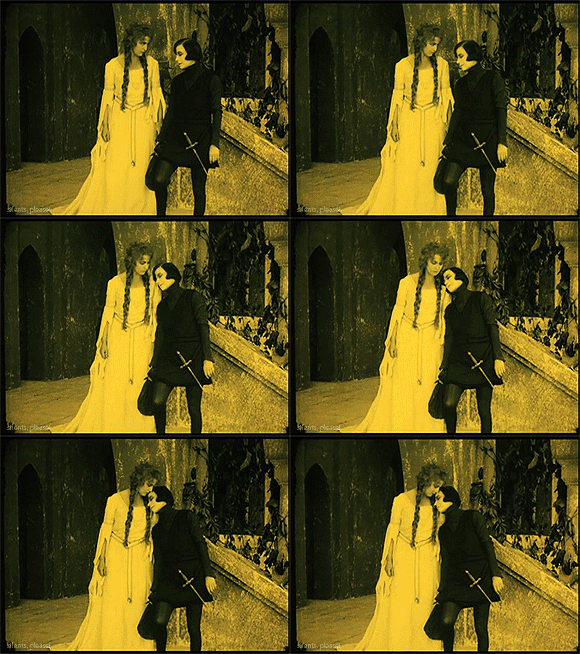
Speaking of silent films, this Hamlette (as per my frantic and impassioned notes) would be inspired by the dark, expressionistic sets of Cabinet of Dr. Caligari. Hamlette herself would be inspired by silent film sirens like Heddy Lamar and Louise Brooks, only more brooding, violent and existential. The movie itself wouldn't be silent, but perhaps the the play within a play would be a 20s silent film depicting the Queens murder in pantomime. The language would be a surreal mix of silent film subtitles, updated modern dialogue and Shakespearean soliloquy.
The last line about this Idea in my notebook is that the whole thing could be shot in stop motion animation. Hmmmm. Needless to say, this idea doesn't sound like what my agent is looking for, so I keep flipping pages, looking through other Ideas.
There are a couple more horror concepts. One is a kafkaesque spin on Gremlins, in which the characters find gummy, oily, spidery creatures called "Things," which turn out to be the "object causes of desire," that inexpressible Thing that we all feel is missing from our lives. Yet when the characters get precisely what they want, their lives become a living hell. There are all sorts of sketches of these monstrous Things growing larger and multiplying out of control.
The problem with this Idea is it feels too familiar (another rash of creature-ids run amok?) and in my notes there are several references to both Buñuel and Lacan, which is always a sign that I'm in trouble...

I keep turning pages. There's a romantic, supernatural thriller called The Philosophers, but it's perverse to the point of being like a Lynch or Cronenberg film, and it's not so much a story as a haphazard list of possible episodes all inspired by the work of my favorite philosophers. Again, I realize that that any combination of period costumes, expensive special effects, and the Ubermensch is going to spell disaster. I continue to dig.
There's a promising Idea of reworking Sleeping Beauty as film noir, in which Sleeping Beauty herself is a femme fatale bent on the Prince's murder. Unfortunately the sketched-out dialogue of knights in full armor speaking in the hard boiled language of Raymond Chandler quickly dissolves into farce. There's a sci-fi, apocalyptic take on the 60's TV series Bonanza. I'll put a pin in that one. There's a supernatural crime thriller about a bunch of con artists who make a billionaire widow believe that they are psychics and have contacted her murdered daughter. I can't decide whether the ghost actually turns out to be real or the con-artists are just turning on each other and fucking with each other's minds. Nahhh, either way it's way too pretentious. What about this story of a narcoleptic who is constantly falling asleep and waking up as a buxom swords-woman in a desert world of alien troglodytes? No. No, swords-and-sandals. I swore to myself, never again.
What the FUCK do I write about??? I close the notebook and pick up the next one on my stack. I'm sure there's an Idea in here someplace...

To find out how I solved this problem check out the follow up article What To Write About...
I'm trying to find an Idea. You know. A three sentence logline with a flashy hook, one that is both tremendously commercial and starkly original. However, all I find scribbled in my notebook (the The Bucket in which I keep all my Golden Story Ideas) are fragments, digressions, and visions for movies that are utterly preposterous.
First, there's "Hamlette." Over my August vacation I saw Benedict Cumberbatch play Hamlet on stage, and I loved the production. I thought, there hasn't been a movie Hamlet lately, not since Ethan Hawke's GenX Dane back in 2000. What if Hamlet were Hamlette, a woman? Sure it has already been done by Danish silent film actor Asta Nielsen, but what if I switched genders of several of the main characters. King Claudius, the villain, would become Queen Claudia, cruel as any grinning Disney witch. The Ghost would be Hamlette's mother, as terrifying as the vengeful spirits in Japanese horror. Hamlet's mother would be Hamlette's father, trading Oedipus for Electra. Hamlette and Ophelia would have a forbidden Sapphic edge.
Speaking of silent films, this Hamlette (as per my frantic and impassioned notes) would be inspired by the dark, expressionistic sets of Cabinet of Dr. Caligari. Hamlette herself would be inspired by silent film sirens like Heddy Lamar and Louise Brooks, only more brooding, violent and existential. The movie itself wouldn't be silent, but perhaps the the play within a play would be a 20s silent film depicting the Queens murder in pantomime. The language would be a surreal mix of silent film subtitles, updated modern dialogue and Shakespearean soliloquy.
The last line about this Idea in my notebook is that the whole thing could be shot in stop motion animation. Hmmmm. Needless to say, this idea doesn't sound like what my agent is looking for, so I keep flipping pages, looking through other Ideas.
There are a couple more horror concepts. One is a kafkaesque spin on Gremlins, in which the characters find gummy, oily, spidery creatures called "Things," which turn out to be the "object causes of desire," that inexpressible Thing that we all feel is missing from our lives. Yet when the characters get precisely what they want, their lives become a living hell. There are all sorts of sketches of these monstrous Things growing larger and multiplying out of control.
The problem with this Idea is it feels too familiar (another rash of creature-ids run amok?) and in my notes there are several references to both Buñuel and Lacan, which is always a sign that I'm in trouble...

I keep turning pages. There's a romantic, supernatural thriller called The Philosophers, but it's perverse to the point of being like a Lynch or Cronenberg film, and it's not so much a story as a haphazard list of possible episodes all inspired by the work of my favorite philosophers. Again, I realize that that any combination of period costumes, expensive special effects, and the Ubermensch is going to spell disaster. I continue to dig.
There's a promising Idea of reworking Sleeping Beauty as film noir, in which Sleeping Beauty herself is a femme fatale bent on the Prince's murder. Unfortunately the sketched-out dialogue of knights in full armor speaking in the hard boiled language of Raymond Chandler quickly dissolves into farce. There's a sci-fi, apocalyptic take on the 60's TV series Bonanza. I'll put a pin in that one. There's a supernatural crime thriller about a bunch of con artists who make a billionaire widow believe that they are psychics and have contacted her murdered daughter. I can't decide whether the ghost actually turns out to be real or the con-artists are just turning on each other and fucking with each other's minds. Nahhh, either way it's way too pretentious. What about this story of a narcoleptic who is constantly falling asleep and waking up as a buxom swords-woman in a desert world of alien troglodytes? No. No, swords-and-sandals. I swore to myself, never again.
What the FUCK do I write about??? I close the notebook and pick up the next one on my stack. I'm sure there's an Idea in here someplace...

To find out how I solved this problem check out the follow up article What To Write About...
Tuesday, March 10, 2015
How To Write Screenplays For Amazon
As I dig into yet another semester teaching at USC, I am showered with questions from students, recent graduates and other emerging writers:
Is indie cinema dead? Are original movie specs, scripts not based on a YA novel or Marvel comic book, a waste of time?What should we be writing now? What will movies and TV series look like in the future? What kind of original content are companies like Netflix and Amazon looking for?
SH: Most screenwriters hope to write an original screenplay and see that screenplay made into a movie. However, nearly all of the movies that were released in 2014 were based on underlying material (sequels, remakes, or adaptations of books). Of the few original screenplays that were nominated for awards, almost all were penned by well-established writer/directors. Especially now that Ted Hope is working with Amazon and Amazon is developing features both for theatric release and streaming, will original spec scripts come back into fashion?
RP: It’s always going to be easier to get your movie made if you’re established and people are dying to work with you or finance you, which is one of the benefits of getting some acknowledgement and recognition. But it’s no illusion that the business is more oriented around sequels and properties today than it was in 1979 or 1959. I’ve heard people lament from time to time that American cinema is not as idiosyncratic or creative as it was in the 1970s. I could quibble with that -- Guardians of the Galaxy was fantastic and kind of whimsical, and I would argue that The Lego Movie has a very distinctive voice that comes from Phil Lord and Chris Miller -- but on the whole, perhaps it is a fair criticism. And it’s not because people are less creative of course, so there should be some awesome ideas out there to unleash on the world.
RP: Yes, we will. Part of the problem with the mid-budget movie is that the distribution windowing fails to maximize revenue associated with those titles. For many “prestige” or “specialty” titles, they get a small theatrical release and some marketing. Some reviews come out. Then it’s in theaters for a few weeks and then it’s gone. Maybe two months later it is available for rental. Maybe seven to nine months after that it might be available in a subscription video service. The audience for many of these movies is older (in movie audience terms -- so like 35+). That audience typically goes out to the theater 3-4 times a year and not usually on the first weekend of a movie’s release. But that’s a lifestyle issue not an interest issue.
 Many people in that group love movies and have money to spend. But if you live in Issaquah, Washington, it’s not always going to be convenient to make it into the city to see the movie. So what happens is that demand is created through the reviews, trailers and the (limited) marketing at a certain time, but the product is not made available until after that demand has dissipated. So the film is distributed in a way that is guaranteed to minimize the economic returns for financiers and filmmakers – in this segment, the windowing has backfired. We think that for these more mature movies for this specific audience, home video windows should be shorter. We also think we as Amazon.com can help these films find their audience in both the theatrical and home video windows.
Some people have tried to set us up in opposition to the theatrical chains, but actually I think we can find a happy, middle way together in this segment. There is still something special for customers and filmmakers about the theatrical experience. It is the best way to see a movie holding all other things equal. So we want to support as robust a theatrical run as a movie can support. We think these mid-range specialty titles need to be more broadly available sooner, but not necessarily immediately. We want to support a strong theatrical run.
So that’s what we plan to do. We think it will be better for filmmakers economically, and we think it will be good for film fans who would like to be able to follow up on great reviews they read about or great trailers they see. I mean ten months later, it can be hard to remember which trailer you loved – was it Puffy Chair or Tiny Furniture? Was it Jeff, Who Lives at Home or Listen Up, Phillip? Too much time has gone by.
SH: Television series like Amazon's Transparent seem to occupy the space that indie films once did in the '90s. Many of my students are inspired by Lena Dunham and the Duplass Brothers. Even in feature screenwriting courses, students most often talk about premium cable series instead of films. Should screenwriters developing sophisticated, character-driven drama and comedy be writing TV pilots instead of features?
People should do what they have a passion to do and what they have original ideas for. There is certainly great work being done in television. But I think the next 10 years will be good for independent cinema, and it is common today to move back and forth between film and TV so it would make sense to be open to whatever form excites you.
Some stories just need to be movies. Other stories call for a longer treatment. And there is a sophisticated at home audience who are eager to support imaginative, nuanced, challenging and original series. I would definitely consider both TV and film.

SH: To what degree is your development slate dominated by established writers (Jill Soloway, Woody Allen) and what percentage of the projects that come to fruition originate from emerging writers (via your website, for example.)
 RP: I think that there is a tendency in TV history for game changing shows to come from new networks or networks that are down on their luck (we’re in the former category!). And I think this happens because these networks are are hungry and open minded. Now that we have had some success in our first efforts, having all our shows hit number one on Amazon, Transparent winning the Globe for Best Comedy and Tumble Leaf winning the Annie for Best Preschool Show, the key for us is to stay open and not just only work with established writers or try to repeat ourselves tonally. We want to stay very open to new ideas and new talent.
We have had thousands of scripts uploaded to our site and evaluated. We have made three pilots and one actual series from scripts submitted to the site (Gortimer Gibbon’s Life on Normal Street). Great show produced for kids 6-11. Check it out. So I am happy we have that pipeline and it’s not just a source of ideas. We put a great team around David Anaxagoras (who created and uploaded Gortimer) and he worked on that show every day. Great for him and for us.
SH: Instead of primarily using traditional network series and classic films as models, should students and younger emerging writers be studying content produced for Amazon, Netflix, Vimeo, and other digital providers to understand the kind of projects that will dominate in the future?
No one knows what will be cool in the future or how narrative forms might evolve. People will tell you to devour the films of the past and that’s definitely helpful, but you can get into a mode where you’re too influenced and you’re copying a bit -- where you’re not influenced by Sullivan’s Travels or whatever, you’re actually basically just redoing Sullivan’s Travels. So you have to see all those older titles and then bring to it your fresh perspective.
And who can argue with that?
Lastly, yesterday Apple announced that HBO will be available for subscribers on Apple TV. We've been hearing about digital streaming for decades, but now (finally) the game may actually be changing. This is good news for writers, filmmakers and artists.

In order to answer some of these questions I caught up with the current head of Amazon Studios, Roy Price. His answers to these and other questions were inspiring for anyone who has been frustrated by the current climate in Hollywood. To give our discussion so context:
Emerging writers and filmmakers often complain that movies can only be made at monster budgets (100 million and above) or micro-budgets (500 thousand or less.) Many iconic filmmakers, like John Waters and David Lynch, have bemoaned The Death of Mid-Budget Cinema (movies budgeted from $5 million to $60 million.) For the last decade, major studios seemed to have (mostly) turned their backs on sophisticated movies for adults, and indie cinema was moribund.
However, Amazon's announcement that producer Ted Hope (21 Grams, In The Bedroom, The Ice Storm) has been hired as its head of production is an exciting and "hopeful" turn. Any writer/filmmaker who has not checked out Hope's blog, read his book Hope for Film: From the Frontline of the Independent Cinema Revolutions, or watched "independent films, classics, silent films, foreign films, documentaries and shorts" on his film site, Fandor, should do so now.
Emerging writers and filmmakers often complain that movies can only be made at monster budgets (100 million and above) or micro-budgets (500 thousand or less.) Many iconic filmmakers, like John Waters and David Lynch, have bemoaned The Death of Mid-Budget Cinema (movies budgeted from $5 million to $60 million.) For the last decade, major studios seemed to have (mostly) turned their backs on sophisticated movies for adults, and indie cinema was moribund.
However, Amazon's announcement that producer Ted Hope (21 Grams, In The Bedroom, The Ice Storm) has been hired as its head of production is an exciting and "hopeful" turn. Any writer/filmmaker who has not checked out Hope's blog, read his book Hope for Film: From the Frontline of the Independent Cinema Revolutions, or watched "independent films, classics, silent films, foreign films, documentaries and shorts" on his film site, Fandor, should do so now.
Amazon itself has won golden globes for its sophisticated and edgy comedy, Transparent, and is now developing a TV series with Woody Allen. What could all this mean for original (but unknown) filmmakers? I spoke to the man who should know.
SH: Most screenwriters hope to write an original screenplay and see that screenplay made into a movie. However, nearly all of the movies that were released in 2014 were based on underlying material (sequels, remakes, or adaptations of books). Of the few original screenplays that were nominated for awards, almost all were penned by well-established writer/directors. Especially now that Ted Hope is working with Amazon and Amazon is developing features both for theatric release and streaming, will original spec scripts come back into fashion?
 |
| Roy Price |
RP: It’s always going to be easier to get your movie made if you’re established and people are dying to work with you or finance you, which is one of the benefits of getting some acknowledgement and recognition. But it’s no illusion that the business is more oriented around sequels and properties today than it was in 1979 or 1959. I’ve heard people lament from time to time that American cinema is not as idiosyncratic or creative as it was in the 1970s. I could quibble with that -- Guardians of the Galaxy was fantastic and kind of whimsical, and I would argue that The Lego Movie has a very distinctive voice that comes from Phil Lord and Chris Miller -- but on the whole, perhaps it is a fair criticism. And it’s not because people are less creative of course, so there should be some awesome ideas out there to unleash on the world.
"At Amazon Studios, we don’t have any properties and we haven’t made any movies, so we won’t be doing a lot of comic book movies or sequels. We’re going to be very filmmaker-driven, looking for interesting, unique films."
SH: Many inspirational filmmakers (David Lynch and John Waters) have called Art House Cinema dead. The studios seem to have stopped making mid-budget films (anywhere from $5 million to $60 million.) This leaves students and emerging filmmakers with no options other than micro-budget films. Will Amazon be making mid-budget movies?
RP: Yes, we will. Part of the problem with the mid-budget movie is that the distribution windowing fails to maximize revenue associated with those titles. For many “prestige” or “specialty” titles, they get a small theatrical release and some marketing. Some reviews come out. Then it’s in theaters for a few weeks and then it’s gone. Maybe two months later it is available for rental. Maybe seven to nine months after that it might be available in a subscription video service. The audience for many of these movies is older (in movie audience terms -- so like 35+). That audience typically goes out to the theater 3-4 times a year and not usually on the first weekend of a movie’s release. But that’s a lifestyle issue not an interest issue.
Many people in that group love movies and have money to spend. But if you live in Issaquah, Washington, it’s not always going to be convenient to make it into the city to see the movie. So what happens is that demand is created through the reviews, trailers and the (limited) marketing at a certain time, but the product is not made available until after that demand has dissipated. So the film is distributed in a way that is guaranteed to minimize the economic returns for financiers and filmmakers – in this segment, the windowing has backfired. We think that for these more mature movies for this specific audience, home video windows should be shorter. We also think we as Amazon.com can help these films find their audience in both the theatrical and home video windows. Some people have tried to set us up in opposition to the theatrical chains, but actually I think we can find a happy, middle way together in this segment. There is still something special for customers and filmmakers about the theatrical experience. It is the best way to see a movie holding all other things equal. So we want to support as robust a theatrical run as a movie can support. We think these mid-range specialty titles need to be more broadly available sooner, but not necessarily immediately. We want to support a strong theatrical run.
So that’s what we plan to do. We think it will be better for filmmakers economically, and we think it will be good for film fans who would like to be able to follow up on great reviews they read about or great trailers they see. I mean ten months later, it can be hard to remember which trailer you loved – was it Puffy Chair or Tiny Furniture? Was it Jeff, Who Lives at Home or Listen Up, Phillip? Too much time has gone by.
"If independent films become more available to film fans when they still remember them and want to see them, opportunities and economic returns will increase for filmmakers and it will be much better for fans too. We expect that this will support more mid-budget features."
SH: Television series like Amazon's Transparent seem to occupy the space that indie films once did in the '90s. Many of my students are inspired by Lena Dunham and the Duplass Brothers. Even in feature screenwriting courses, students most often talk about premium cable series instead of films. Should screenwriters developing sophisticated, character-driven drama and comedy be writing TV pilots instead of features?
People should do what they have a passion to do and what they have original ideas for. There is certainly great work being done in television. But I think the next 10 years will be good for independent cinema, and it is common today to move back and forth between film and TV so it would make sense to be open to whatever form excites you.
Some stories just need to be movies. Other stories call for a longer treatment. And there is a sophisticated at home audience who are eager to support imaginative, nuanced, challenging and original series. I would definitely consider both TV and film.
"We have had thousands of scripts uploaded to our site and evaluated. We have made three pilots and one actual series from scripts submitted to the site."
SH: To what degree is your development slate dominated by established writers (Jill Soloway, Woody Allen) and what percentage of the projects that come to fruition originate from emerging writers (via your website, for example.)
RP: I think that there is a tendency in TV history for game changing shows to come from new networks or networks that are down on their luck (we’re in the former category!). And I think this happens because these networks are are hungry and open minded. Now that we have had some success in our first efforts, having all our shows hit number one on Amazon, Transparent winning the Globe for Best Comedy and Tumble Leaf winning the Annie for Best Preschool Show, the key for us is to stay open and not just only work with established writers or try to repeat ourselves tonally. We want to stay very open to new ideas and new talent. We have had thousands of scripts uploaded to our site and evaluated. We have made three pilots and one actual series from scripts submitted to the site (Gortimer Gibbon’s Life on Normal Street). Great show produced for kids 6-11. Check it out. So I am happy we have that pipeline and it’s not just a source of ideas. We put a great team around David Anaxagoras (who created and uploaded Gortimer) and he worked on that show every day. Great for him and for us.
SH: Instead of primarily using traditional network series and classic films as models, should students and younger emerging writers be studying content produced for Amazon, Netflix, Vimeo, and other digital providers to understand the kind of projects that will dominate in the future?
No one knows what will be cool in the future or how narrative forms might evolve. People will tell you to devour the films of the past and that’s definitely helpful, but you can get into a mode where you’re too influenced and you’re copying a bit -- where you’re not influenced by Sullivan’s Travels or whatever, you’re actually basically just redoing Sullivan’s Travels. So you have to see all those older titles and then bring to it your fresh perspective.
My view is that whatever you’re watching, the advantage you have is that you are the only one that has your perspective. Writers of the past didn’t have the opportunity to write in 2015 or 2016.
"...you have to understand the essential, permanent, Aristotelian elements of storytelling, etc., from the old movies, plays, novels, etc., but then put your own bad self into it."
SH: Paul Schrader was quoted in Variety “My feeling about Amazon and Netflix is that they are probably going to be even more brutal than independent equity money, because they are at heart number crunchers, not filmmakers.” Yet, series like Transparent seem to suggest a willingness to take risks. Is Amazon going to allow more creative freedom? And if so, should emerging filmmakers be focusing more on original and challenging subject matter instead of developing ideas that seem commercial or marketable?
Well, bear in mind that we’re in this to create really distinctive and memorable work that people will care about and that will live on our site for a long time. So these aren’t one off economic propositions for us as they may be for strictly financial players. We’re only interested in doing great work so we are going to create an environment where great work can be created. I would point out that Mr. Schrader’s concerns have not been borne out so far on the TV side.
People should do what moves them and this is a great time to do something unique. That said, there are economic reasons for making TV shows in standard formats (basically so you can resell them to other people later and defray investment). So there is an argument for doing something at a standard length. But the first priority should always be to do what works. So I would do that.
Roy's last words of advice were these...
Well, bear in mind that we’re in this to create really distinctive and memorable work that people will care about and that will live on our site for a long time. So these aren’t one off economic propositions for us as they may be for strictly financial players. We’re only interested in doing great work so we are going to create an environment where great work can be created. I would point out that Mr. Schrader’s concerns have not been borne out so far on the TV side.
 |
| Transparent |
"Creating great work requires creating a great environment for filmmakers."
SH: Since the "typical" TV series is a thing of the past, can students and filmmakers play with the form? For example, I know a student developing a series with 90 minute episodes and a four episode arc. Others have considered 20 minute episodes or episodes of varying length like chapters in a book. Streaming seems to allow for all sorts of creativity when the episodes are confined to time slots and airing dates. What do you recommend?
SH: Since the "typical" TV series is a thing of the past, can students and filmmakers play with the form? For example, I know a student developing a series with 90 minute episodes and a four episode arc. Others have considered 20 minute episodes or episodes of varying length like chapters in a book. Streaming seems to allow for all sorts of creativity when the episodes are confined to time slots and airing dates. What do you recommend?
 |
| Mozart In The Jungle |
Roy's last words of advice were these...
"If you want to outsell Pat Boone you don't do it by being extra Pat Boone-y, you do it by being the Rolling Stones."
Lastly, yesterday Apple announced that HBO will be available for subscribers on Apple TV. We've been hearing about digital streaming for decades, but now (finally) the game may actually be changing. This is good news for writers, filmmakers and artists.
Other Genre Hacks Interviews with Roy Price:
- (2011) Amazon Studios: An Interview with Roy Price
- (2012) Amazon Studios 2.0 - Another Interview with Roy Price
Thursday, January 16, 2014
Writing The Feature Script: Week One - OVERVIEW
For the next 15 weeks I will be teaching "Writing The Feature script" at USC's School of Cinematic Arts. Week by week I will be writing blog articles about each topic that we discuss in class. My hope is that beginning screenwriters, working screenwriters in writing groups, and screenwriting professors might benefit from "auditing" my class online.
On Tuesday of this week, I began the first class by pointing at the elephant in the room. Only the weekend before The Legend of Hercules opened to scathing reviews and a score on Rotten Tomatoes of 2%. Those students who had checked out my other credits on the Internet Movie Database had seen other dubious titles like Conan the Barbarian and Halloween: Resurrection. Why would anyone want to take a class taught by a screenwriter best known for a viral posting called What's It Like To Have Your Film Flop At The Box Office?
As it turns out, I'm a much better writer than my credits would suggest (trolls may begin mocking and sniping here) but that's not my point. Most of what it takes to write a successful film (talent, hard work, self-delusion, and truckloads of good luck) can't be taught in the classroom. What I teach, to the best of my ability, is a process by which students can discover their own voice and improve the quality of their own stories through a cycle of ongoing retelling and revision.
In other words, the class isn't about me. Having written some two dozen projects for film and television, I can offer advice about the industry and about what standard students must meet in order to be "professional." However, the class is about the students' work, and about introducing them to tools to put their vision on paper. I share these concepts both in class and online in the hopes that I can help someone out there - someone with talent, passion, and the necessary self-delusion - to make a truly great film.
You can read about some of the concepts I will emphasize in the class here: This Is What A Rewrite Looks Like.
For what it's worth, my class gets pretty stellar student reviews. If there were a Rotten Tomatoes for screenwriting courses, I'd get a 98%. I've heard that one of the best-screenwriting-courses-ever at UCLA is taught by a guy credited on Battlefield Earth. Go figure.
You can read about Week Two here: FINDING THE STORY
You can read about Week Two here: FINDING THE STORY
Here is the syllabus for the course...
School of Cinematic Arts
Writing Division
CTWR 533a: Writing The Feature Script
Instructor: Sean Hood
Class Schedule: 4:00-6:50pm Tuesday
Office Hours: By appointment – preferably Tuesday afternoon before
class.
Email Address: genrehacks@gmail.com
Course Objective:
The objective of this course is to learn the craft of screenwriting,
to develop it through pitches and treatments, to hone it by generating
and receiving notes, and to apply it
by completing a first draft of an
original screenplay.
Course Description:
Amateur screenwriters and “how-to” screenwriting manuals are
commonplace in Hollywood. This course is
designed to give students the tools to approach the screenwriting process from
the perspective of a professional
filmmaker and to face the challenge with both confidence and creativity.
The class will lead students step-by-step through the creation
of an original feature script, moving from broad discussions of the author’s story,
to a more detailed beat sheet, and finally to the sequence by sequence writing
of the first draft. Our emphasis will be
on story and character fundamentals. Issues
of originality and “personal voice” will be balanced with those of
professionalism and process.
This course will not only help students to write scripts, it
will allow them to practice skills of analysis, discussion and presentation
they will need in future projects throughout their professional careers. With
this in mind, students will be expected to participate in all discussions and
to help their fellow students develop their outlines and screenplays, “working
on their feet.”
Ultimately, each student is required to complete a feature
screenplay by the end of the semester.
The final script must be at least 100 pages in length and have a completed third act. It must display both character development and a basic understanding of the screenplay elements discussed in class.
Since each screenplay offers unique challenges for each
writer, the instructor will take into account the progress of each student on
an individual basis.
Course Reading:
Students will be required to read each other’s weekly
assignments. Because of the sheer volume of this material as well as the time
and care taken in its analysis, additional required reading will be minimal.
Weekly selections from screenwriting books and articles written by the instructor that
pertain to the class will be made available to students online.
Assignment and Deadlines:
The WRITING
ASSIGNMENTS will be due by MIDNIGHT
SUNDAY previous to each class. This is a firm deadline and the late
delivery of assignments will impact your grade for the course. If you finish
the work earlier, please send it in.
You’ll be expected to come to class having finished typed NOTES on your colleagues’ pages
for class discussion. Please deliver your notes to each respective writer (and
to the instructor) TUESDAY, after class.
If students run into conflicts with shooting schedules or professional
obligations, and they cannot meet a particular deadline, they can consult the
professor no later than the Monday before the deadline. As in professional situations, adjustments to
deadlines can sometimes be made if the student plans a week or two in advance.
Grading Criteria:
Grading will depend on the quality and ambition of student’s
written work and in-class presentations, as well as the student’s involvement
in discussions of other’s work.
The course aims to prepare students to be working
professionals. With that in mind grading will reflect the standards and
expectations students can expect to encounter in the “real world.” So, all
assignments must be submitted on time. Students must attend all
classes, arriving on time. Students who cannot make a class or complete an
assignment must contact the professor via email or through the front office before
they miss a class or fail to complete an assignment.
When judging a screenwriter’s work, industry professionals
often ask if a writer can “deliver.” Professional work is “delivered” on-time,
proofread, and carefully thought out. Slip-shod or hurried work is rarely
tolerated. So in determining a final grade, hard work and professionalism will
be as important as originality and skill.
Likewise, working as a professional requires the skills of
collaboration and communication. So as they would be in any story meeting in
the entertainment industry, students are expected to be involved in each and
every discussion. Failing to read the other students’ material or work on the
other students’ ideas will affect the final grade.
Specific areas that will be considered in determining a
final grade are:
- Classroom Participation – 5%
- Written Feedback (Notes) – 5%
- Treatment/Beat Sheet – 10%
- Classroom Presentation (Pitch) - 10%
- Bi-Weekly Revised Pages – (10% each) 40%
- Final polished screenplay – 30%
Class Schedule
Week 1 – Tuesday, January 14
·
Lecture - Overview of Class
o
Review of Syllabus.
o
Discussion of class goals.
o
Giving and receiving professional feedback
(notes.)
o
Screenplay Terms
o
Introductions
Assignment Due – Sunday, January 19, Midnight
Week 2 – Tuesday, January 21
·
Lecture: Introduction to three act structure.
·
Discussion on the World of the Story and the
Protagonist.
·
Class discussion on the screenplay ideas
submitted on January 19.
Assignment Due – Sunday, January 26, Midnight
·
Students will write an exploration of the World
they are setting their story in or a monologue/letter from their main
character’s point of view. 2 to 3 pages.
Week 3 – Tuesday, January 28
·
Lecture: How to create a Treatment or Beat
Sheet.
Assignment Due – Sunday, February 2, Midnight
·
GROUP A delivers a 2-3 page Beat Sheet or
Treatment.
·
Each student in GROUP A makes an Appointment With The Professor to discuss his/her Beat Sheet
or Treatment.
Week 4 - Tuesday, February 4
·
Lecture: Pitching
·
Lecture: Using index cards, character trees and
other tools to create a map of primary characters, relationships, and arcs.
·
Class discussion: Breaking Story. Deliver
written notes on GROUP A Beat Sheets.
Assignment Due – Sunday, February 9, Midnight
·
GROUP B delivers a 2-3 page Beat Sheet or
Treatment.
·
Each student in GROUP B makes an Appointment With The Professor to discuss his/her Beat Sheet
or Treatment.
·
Group A prepares for Oral Presentation (pitch.)
Week 5 - Tuesday, February 11
·
GROUP A gives Oral Presentations (i.e.
each give a 20 minute pitch) to the class.
·
GROUP A presents the class with a Revised
Beat Sheet.
·
Class discussion/feedback on GROUP A pitches and
Beat Sheets.
·
Deliver written notes on GROUP B Beat Sheets.
Assignment Due – Sunday, February 16, Midnight
·
GROUP A begins writing their first two
sequences.
·
Group B prepares for Oral Presentation (pitch.)
Week 6 - Tuesday, February 18
·
GROUP B gives oral presentations (i.e. each give
a 15 minute pitch) to the class.
·
GROUP B presents the class with a Revised
Beat Sheet.
·
Class discussion/feedback on GROUP B pitches and
Beat Sheets.
Assignment Due – Sunday, February 23, Midnight
·
GROUP B begins writing their first two
sequences.
·
GROUP A delivers Sequences One and Two (The
first Act)
Week 7 - Tuesday, February 25
·
Lecture: Excavating Structure. How to be open to
discoveries during the writing process. The concept of “theme”.
·
Discussion and analysis of GROUP A’s work. Deliver written notes.
Assignment Due – Sunday, March 2, Midnight
·
GROUP B delivers Sequences One and Two
(The first Act)
Week 8 - Tuesday, March 4
·
Lecture: The “Mid-Point” and the “Mid-Point
Shift”.
·
Discussion and analysis of GROUP B’s work.
Deliver written notes.
Assignment Due – Sunday, March 9, Midnight
·
GROUP A delivers revised Sequences Three and Four
(up to the Midpoint)
Week 9 - Tuesday, March 11
·
Lecture: How to clear the Big Hurdle that is the
second half of the second act.
·
Discussion and analysis of GROUP A’s work.
Deliver written notes.
SPRING BREAK
Assignment Due – Sunday, March 23, Midnight
·
GROUP B delivers revised Sequences Three and Four
(up to the Midpoint)
Week 10 - Tuesday, March 25
·
Lecture: Discussion on “Culmination” -- the End
of the Second Act.
·
Discussion and analysis of GROUP B’s work.
Deliver written notes.
Assignment Due – Sunday, March 30, Midnight
·
GROUP A delivers revised Sequences Five and Six
(Complete Second Act)
Week 11 - Tuesday, April 1
·
Lecture: How to prepare the audience for the 3rd
Act.
·
Discussion and analysis of GROUP A’s work.
Deliver written notes.
Assignment Due – Sunday, April 6, Midnight
·
GROUP B delivers revised Sequences Five and Six
(Complete Second Act)
Week 12 - Tuesday, April 8
·
Lecture: The Final Act. Audience expectations.
The concept of a “satisfying story”.
·
Discussion and analysis of GROUP B’s work.
Deliver written notes.
Assignment Due – Sunday, April 13, Midnight
·
GROUP A delivers revised Sequences Seven and Eight
(The Third Act)
Week 13 - Tuesday, April 15
·
Lecture: A second look at “Theme” and the “Main
Question” of your story.
·
Discussion and analysis of GROUP A’s work.
Deliver written notes.
Assignment Due – Sunday, April 20, Midnight
·
GROUP B delivers revised Sequences Seven and Eight
(The Third Act)
Week 14 - Tuesday, April 22
·
Lecture: Strategies and tools for the Polish.
·
Discussion and analysis of GROUP B’s work.
Deliver written notes.
Assignment Due – Sunday, April 27, Midnight
·
Commence polishing the Revised Draft.
·
Students who are behind may deliver final
sequences for feedback.
Week 15 – Tuesday, April 29
·
Discussion on the Polished Pages, Late Sequences
and Lingering Story Problems
Week 16 - Optional Class – Friday, May 6
·
Final discussions, notes and encouragement. (Class
Lunch)
FINAL ASSIGNMENT DUE – Sunday, May 11, Midnight
As a final assignment and for the determination of a final
grade students must deliver to the professor a complete revised and polished
screenplay.
This final draft must include the various discussed in
class, completed character arcs, and a completed third act. The quality of the scripts
will be evaluated in context of the goals set by the writer earlier in the
semester.
The final draft, in terms of professionalism and polish,
should be suitable for submission to a producer, agency, studio, actor or
independent financier.
I write this blog in order to connect with intelligent, ambitious, and creative people. If you leave a comment, you will inspire me to write more. If you liked the article, please share it.
I write this blog in order to connect with intelligent, ambitious, and creative people. If you leave a comment, you will inspire me to write more. If you liked the article, please share it.
Monday, January 13, 2014
Drawing Pictures For Screenplays: IMPS
When I was in college, it never occurred to me that I would be a professional writer. I majored in art and in mathematics, but what I secretly dreamed of being was a simple illustrator or cartoonist. Now, when I come up with movie ideas, they appear to me, not as loglines or one-sheets or even cinematic images. They pop into my head as drawings. So when I'm trying to get my head around a movie idea, I draw pictures.
For example...
 Many years ago, I kept imagining creatures that I called "imps." An imp is defined as "a little devil or demon; an evil spirit," but I saw them as the size of forest sprites, covered in bundled twigs, with wings like dry leaves.
 I imagined them infesting suburban backyards like termites or bees. They didn't strike me as "evil" so must as mischievous, ill-behaved and playfully destructive. They looked like the manifestation of every child's id, and I could see them coming by the thousands to wreak havoc on family homes.
This ultimately became a story about a group of children whose old house had become overrun with the creatures. The kids try to drive the imps out, but when there are two-year-old sister is abducted, they have to venture into the Imps' hive to rescue her.

At the time I had just finished writing assignments adapting novels about serial killers, madmen, and demonic possession. I think I was just in the mood to do something more playful lighthearted.
 But the Imps kept changing form...
 Suddenly, I was imagining them not covered in bundles of sticks, but actually composed of tangled vines and roots.

 But the Imps didn't stop changing. The kept getting more and more disturbing. They took the form of grotesque human-wasps. So, the stories that these new pictures evoked kept changing too, becoming darker and more perverse. Now, I imagined sociopathic entomologists breeding sick mutations in test tubes and terrariums, only to have them break out (as our creatures always seem to do) to take revenge on their creators.
However, just when I had this version of the Imps down in treatment form, the image unexpectedly morphed again - transforming into something altogether different.

 Now, I imagined a group of girls, young witches, who cast spells to invoke the imps. Each Imp could perform a task, sometimes simple, like finding a lost iPhone, sometimes more complicated, like making a boy fall madly in love, and sometimes extremely dangerous, like raising the dead.
The girls loved their Imps like unicorns - if unicorns look like horned gargoyles.
I pitched all these versions of imps and more to various production companies, producers, comic book publishers, and networks. None of the imps, in any of their various incarnations, were ever sold. For years I hadn't thought about them, but this morning I stumbled on the sketchpad packed with all the different drawings I have made over the years, trying to pin the imps down.
Alas, I could never quite get a handle on the little fuckers. Perhaps it's just not in an Imp's nature to be pinned down.
My favorite imp of all the imps I found the sketchpad, was drawn by my six-year-old daughter (she's thirteen now) - the most mischievous, playful, unpredictable imp of all:

I write this blog in order to connect with intelligent, ambitious, and creative people. If you leave a comment, you will inspire me to write more. If you liked the article, please share it.
Friday, May 25, 2012
Movie pitches, Startup Pitches

I have developed pitches to studios, to networks and premium cable, and to "angel investors" for both startups and indie films. In the next eight weeks, I'll be pitching a TV series pilot, a feature film spec, and I will joining a larger team to pitch a startup to VC's. Quite a lot comes to mind when I compare the two worlds, especially as those worlds continue to merge.
So check out my answer on Quora to...
Venture and Investor Pitches: In what ways is a Hollywood film pitch similar to a Venture Capital pitch for a startup?
I have developed pitches to studios, to networks and premium cable, and to “angel investors” for both startups and indie films. In the next eight weeks, I’ll be pitching a TV series pilot, a feature film spec, and I will be joining a larger team to pitch a startup to VC’s. Quite a lot comes to mind when I compare the two worlds, especially as those worlds continue to merge.
Honestly, the biggest similarity is just the anxiety and dread I inevitably feel before attempting to sell myself and my idea. People attracted to screenwriting and technology (or both) tend to be introverts and not natural salespeople. Pitching to anyone about something you care deeply about can feel like going up on stage to do a tap dance routine… wearing clown make-up and a speedo.
However, my personal neuroses aside, I’ve noticed three fundamental similarities:
- You Must Tell A Story
You begin the pitch with a hook that grabs attention of your audience and moves them emotionally. They think, “Wow, this is a story I want to hear.” Then you tell a tale about people with a BIG problem and a hero with a unique solution. The story is exciting because both the hero and the people want something very, very badly, but there are seemingly insurmountable obstacles to getting it. The story ends with a payoff, punchline, twist, a solution, and the audiences say “Ahhhhh, now I understand!”
The best pitches I have ever heard seem effortless. They are delivered like a spellbinding anecdote told over martinis at a dinner party. If the pitch is for a startup, the protagonist is the entrepreneur him/herself, but the structure of the story is the same: a big problem with unique solution executed by heroes who are the only ones for the job. The “twist” or “punchline” of the story is (in startup lingo) your “secret sauce.” It’s the unique quality of hero, his or her “superpower,” that will allow him/her to save the day.
These stories are told with passion. They aim for the maximum emotional impact and personal connection with the audience. Charisma, eloquence, and authenticity are all essential when pitching your story.
However…
- It’s All About Execution
In both stcreenwriting and startup circles you often encounter the meme:Your Idea Means Nothing.
Well, this isn’t exactly true. Said Michael Wolf, “I’ve never met a VC who told an entrepreneur, ‘don’t tell me about your idea since it doesn’t matter!’” Likewise, I’ve never met a producer or studio executive who told a screenwriter, “Don’t bother pitching me your story. Ideas don’t matter. It’s all about execution!”
However, when you walk into an office to pitch a great idea, what you are really selling is your execution of that great idea.
This often comes down to who is already “attached” to the project. In movies and television, this means that a major star, a powerful producer, or a hot director has already committed to doing your project should it get set up. Likewise, in start-ups, it’s good to have a great programmer, a great marketer, proven businessman, or some other “rockstar” on your team.
For example, if you went into a room and pitched a dark tale of madness set among dancers in a production of the ballet “Swan Lake,” you would likely be shown the door. However if your director is Darren Aronofsky and your star is Natalie Portman, you have a much better shot.
Perhaps the key element in the execution piece is answering the question “How the hell does this make money?“ In movies, this often comes down to having the exclusive rights to a “property,” a popular book or famous movie that can be remade. Having a built-in audience assures the investor that that there is enough potential interest in the story to turn a profit. In startups, this often comes down to a “proprietary technology,” something that distinguishes you in an established and lucrative marketplace. In both cases, the burden is on you to convince the investor that there are actually people or businesses out there who might pay money if your idea is realized.
- Who The Hell ARE You, Anyway?
“Who you are” will set the tone, the receptiveness, and level of enthusiasm in the meeting before you even walk in the door. Often, I can sense how a pitch is going to go, just by gauging the energy of the participants in the first 60 seconds.In both worlds, it’s easiest to pitch to people who either already know you or already know you for something. Whether you have already had a popular movie, sold a spec script, been a key player in a successful company, or just have “buzz” around you and your project(s), it’s good to have “heat.”
Let’s face it, if you pitch a Question and Answer website, no matter how good your idea may sound, nobody is likely to care unless you just happen to have been players in the development of Facebook.
If you are unknown to the person you are pitching to, the first thing they will do before the meeting is google you.
For example, before a movie pitch, the executive will first look at my IMDB page and my blog, both of which (for better or for worse) show up on the first page of my Google results. Likewise in startups, your online “brand,” as defined by your Linkedin profile, online articles written about you, or your website itself, will define “who you are.”
If you are a complete unknown and have no established reputation, what matters is who you know. Someone important - a powerful agent or producer, a powerful entrepreneur or expert in your business – has to vouch for you to get you in the room.
“Who you know” is particularly important because of the notoriousnepotism and cronyism in the film and television industry. Truth be told, the best way to sell a pitch (or to become an actor, director, or producer) is to be the related to somebody famous. While connections matter in every business, the startup world is far more concerned with proven qualifications. Hollywood is NOT a meritocracy.
For example, if an entrepreneur graduated at the top of his class from Harvard, Stanford, MIT, or Caltech, with a host of awards and achievements, it would carry weight with a potential investor. Conversely, I graduated fromUSC School of Cinematic Arts, arguably the best and most Hollywood-connected film school in the world, I had close to a 4.0 grade average, and I won several awards and scholarships. Yet, while the time I spent there was invaluable to me in my development as a filmmaker, my USC degree means virtually nothing to anyone listening to a movie pitch.
- Bonus Similarity – The Rejections
Even if a pitch is ultimately bought, 99% of the people you talk to are going to say, “no.” It takes a lot of strength, dignity, and most of all, passion to weather the long storm of rejection and indifference. The King’s Speech took a decade to get funded, even with Geoffrey Rush attached.
In both worlds, the job of the people you are pitching to is to say NO. Their task is to listen to dozens of pitches a day and figure out a good reason to pass on almost all of them, because they (and their companies) can only say yes to a very limited number of projects. You can’t take it personally, and you can’t see the rejection or even many “reasons” given for a pass as indictment of your core idea. You just have to take a deep breath, make adjustments if necessary, and move on to the next one.
The only thing you have to keep you going through the long slog is the (sometimes delusional) belief in your core idea and the authenticity of your “story.”
So, as it turns out, whether or not you have hot properties, great connections, or rockstar attachments, your “story” may indeed be the most important thing after all.
Subscribe to:
Posts (Atom)